


Jane Fonda fought depression through physical fitness
The most accomplished people in history discovered the same antidepressant: total absorption in meaningful work
STUDY: D’Agati DV et al, International Journal of Bipolar Disorders 2026
STUDY TYPE: Review
FUNDING: Independent
Background
This narrative review looks at six historical figures with mood disorders who arrived at a common strategy to fend it off, a strategy that also ranks at the top of CBT techniques.
The people reviewed likely had affective temperaments — hyperthymic, cyclothymic, irritable, or depressive. These traits are common in mood disorders, especially bipolar II where nearly 50% have one. People with these temperaments carry outsized creative gifts, but also a persistent vulnerability to severe depression.

Robert Burton (1577–1640)
Burton wrote The Anatomy of Melancholy, a six-volume, half-million-word masterwork still in print 400 years later. He grew up in a loveless home, fell into a severe depression as an Oxford student, dropped out, and was barely functional for years. Mental illness ran in his family. Today he’d likely be diagnosed with bipolar disorder and cyclothymic temperament. Medicine couldn’t help him, so he did what any obsessive polymath would do: he researched his way out.
“I write of melancholy by being busy to avoid melancholy,” he wrote. Staying constantly occupied, especially in creative work, kept his mood afloat. He couldn’t tolerate even an hour alone or idle without feeling depression creep back in. When he sensed it coming, he’d head to the docks to watch longshoremen curse and shout at each other until he laughed.
Samuel Johnson (1709–1784)
Johnson compiled the first true Dictionary of the English Language, illustrating 140,000 definitions with examples drawn from his extraordinary memory. He dropped out of Oxford during a severe depression and carried what he called “this vile melancholy” his entire life, inherited from his father. His brother likely died by suicide at 24.
Johnson lived in constant fear of losing his mind. He bought padlocks and fetters in his fifties, terrified he might lose control entirely. His depressions brought overwhelming anxiety and physical prostration. The nine years he spent on the Dictionary were the most emotionally stable of his life. He believed activity had to match one’s gifts, not mere busyness, but “a task worthy of [oneself].”

Meriwether Lewis (1774–1809)
Lewis led the most ambitious overland expedition in American history, crossing the North American continent to the Pacific and back. Thomas Jefferson chose him deliberately, knowing his father had suffered periodic depressions but betting that Lewis’s fearlessness, physical strength, and natural leadership would carry the mission. He was right.
For three years, Lewis faced grizzly bear attacks, near starvation, brutal winters, hostile tribes, and epidemic illness, and thrived. Depression didn’t significantly touch him during the expedition. The relentless demands of survival consumed him completely. But back in civilization, given a bureaucratic government post and surrounded by petty infighting, he collapsed. He fell into depression and alcoholism and died of a self-inflicted gunshot wound at 35.
In his epitaph, Jefferson’s note that “the constant exertion” of the expedition had suspended his “depressive afflictions”; sedentary life brought them back with doubled force.

Winston Churchill (1874–1965)
Churchill lead the British to victory as prime minister in WWII. His mother was neglectful, his father dismissive, and mood disorder ran through the family. He fell into a two-year depression as a young man. Today he’d likely be diagnosed with bipolar disorder and hyperthymic temperament. The same relentless energy and unwavering optimism that made him indispensable to Britain in its darkest hour also drove heavy drinking, gambling binges, and occasional catastrophic misjudgments.
He called depression his “Black Dog” and understood it well enough to fear stillness. He was never happy, as one close observer noted, unless fully occupied, asleep, or holding the floor. When fatigue set in, he didn’t rest — he switched activities. He built walls (he was a skilled mason), painted (he became an accomplished painter), or wrote history (his histories won the Nobel Prize). His final five years in full retirement were spent in near-silent depressive torpor. He told his family: “I have achieved a great deal to achieve nothing in the end.”
Churchill’s story recalls president Theodore Roosevelt, who suffered depressions and had a family history suggestive of bipolar disorder. Roosevelt believed he could ward off depression (which he called “black care”) through “The Strenuous Life,” combating emotional distress through vigorous physical exertion, constant intellectual stimulation, and deep immersion in the wilderness.

William Osler (1849–1919)
Osler founded modern medical education, transforming Johns Hopkins into the model every medical school since has tried to copy. He had extraordinary empathy, prodigious energy, and the rare ability to earn immediate trust from patients and colleagues alike. One biographer noted he had “tendencies toward depression which he could not always disguise” by keeping up his relentless schedule.
Osler prescribed what worked for him: fill the day with focused, meaningful work, and reserve 15 minutes before bed for reading outside medicine — literature or religion. Don’t look backward; don’t look forward. Just work through the 16 waking hours in front of you. He also insisted on a hobby, pursued vigorously. “Straddle it and ride it hard,” he told his students. When he moved to England and found himself with a lighter schedule and a bureaucracy impervious to his talents, he fell into a major depression in his fifties, much like Lewis before him.
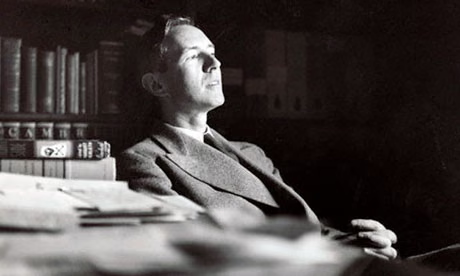
Jacques Barzun (1907–2012)
Barzun was an eminent scholar of cultural history, a field that encompasses politics, religion, philosophy, science, art, music, and daily life across five centuries. His 800-page magnum opus, From Dawn to Decadence, is generally considered a work only he could have written. He grew up in a glittering Parisian household where composers and poets dropped by; the poet Apollinaire taught him to tell time. World War I shattered that world.
By age 11 he was severely depressed, even suicidal. His energy throughout life was unusual: five hours of fitful sleep was enough; he started his magnum opus at 83 and finished it at 90, alongside 40 other books and hundreds of essays. Whether he had a true bipolar temperament isn’t certain, but his advice echoed every figure in this group. Life, he said, is like riding a bicycle: look straight ahead and keep pedaling. Stop and look down and you fall. Happiness, he believed, comes from momentum, which also leaves no time, as he wryly noted, to whine and groan.

What About Women?
The article only covered men, but several legendary women arrived at a similar strategy.
Fitness guru Jane Fonda has spoken of her family history of depression, saying “the best way to fight depression is to keep moving.”
J.K. Rowling grappled with severe clinical depression before achieving literary fame. She channeled her pain into her work, using her darkest emotional states as the inspiration for the soul-sucking “Dementors” in the Harry Potter series.
Lady Gaga is candid about her lifelong battles with anxiety and clinical depression. When early signs of depression arose, she poured herself into her work as a musician and actor.
Gwyneth Paltrow said that diving into acting projects and staying hyper-focused on her work helped her come out of depression after her father died.
Actor Busy Philipps relies on a strict, daily physical workout routine to keep her brain calm, noting that breaking a sweat is essential to lifting the “fog of sadness” and allowing her to remain a productive, focused mother and professional.
Conclusion
Necessity is the mother of invention. Just as dyslexia can force people to develop extraordinary skills to compensate, so too with depression. In this case, the skill is total immersion in an all-consuming project.
Behavioral therapists call it absorption, and it stood out as the most effective therapeutic technique to counter depression in a large study of CBT. Absorption is more than staying busy. It calls for work that is meaningful, draws on our talents, and is challenging enough to hold our attention. Here’s a full list of the qualities.
Practice Implications
- Telling people with depression to just get busy can be invalidating and unrealistic.
- On the other hand, the strategy is backed by trials of behavioral activation therapy. When done carefully and with a therapist, it treats even severe depressions.
- Learn how to recognize the affective temperaments with the TEMPS-A rating scale. They are also common in ADHD, as explained in our ADHD vs Bipolar podcast.
— Chris Aiken, MD
Director, Psych Partners
Editor in Chief, Carlat Psychiatry Report


